Faces
- iowisota
- Jan 31
- 4 min read
The weathered faces reveal lifetimes of adversity. They aren’t human faces; they are the rocky crags that look out over the Mississippi River. Each face is unique and beautiful, full of character. Their expressions change throughout the seasons and even throughout the day, with the nuances of snow and cloud, shadow and sun.
The rocky faces of the bluffs reveal layers of limestone and dolomite of the ancient Paleozoic Plateau. This plateau of sedimentary rock was not scraped or buried by the last 3 to 4 glaciers, but it also wasn’t untouched. Meltwater floods cut valleys and reorganized the landscape, moving massive quantities of rocks and soil. Meanwhile, the rocky escarpments weathered to the faces that still watch over the now quieter rivers and valleys.

These faces have been present for a very long time, and they hide secrets. Some faces have rock overhangs and nooks forming protected pockets. Other people lived on this land for hundreds of years between when the last glacier left and when Europeans arrived. I wonder what I could find in those hidden cavities or shelters. Petroglyphs? Tools left behind? Other artifacts? I’m sure someone more athletic and braver than I would have long since explored the farthest reaches and removed any treasures, so most likely I would only find a few animal bones and other debris. Still, I do wonder what secrets the faces hide.
The faces are a place of refuge. Deep crevices in the cliffs offer protection from hot and cold extremes, and when fires swept up the hillside prairies, the rock faces escape the flames. The term “refugium” literally means a place that supports an isolated or relict population of an organism. Protected spaces can serve as refugia, and you may find rare and unique plants and animals on these sensitive sites. Words like karst topography, algific talus slopes, Pleistocene snail, and northern wild monkshood come up in conversation about refugia and the Driftless Area, but I don’t know if my local faces are home to any rare plants and animals.
The faces harbor danger, in the form of steep cliffs, unstable rocks, and venomous snakes. Nature doesn’t install guardrails to protect the foolhardy, and the edges are not always stable. There may be a ledge to stop my fall down the steep cliff, or there may not be. So, I keep a safe distance from the edge. The lower slopes of the bluffs are littered with boulders that were once part of a face, until erosion and gravity prevailed and they came crashing down. Rocks may break free at any time, but landslides and rock falls from the faces are more common in Spring (following the freeze-thaw cycle) and after heavy rains. And then there are the rattlesnakes. They shelter in the cracks that extend deep into/under the cliffs and bask in the sunshine on ledges and rock shelves. In fact, they need the deep cracks and fractures that lead back into protected dens where they can overwinter; that’s why we have rattlesnakes here in the Driftless Area, but not in the rest of Iowa. The timber rattlesnakes aren’t usually aggressive, but they don’t really like getting cornered or stepped on. I don’t like to be surprised by them any more than they like to be surprised, so I tread with caution.

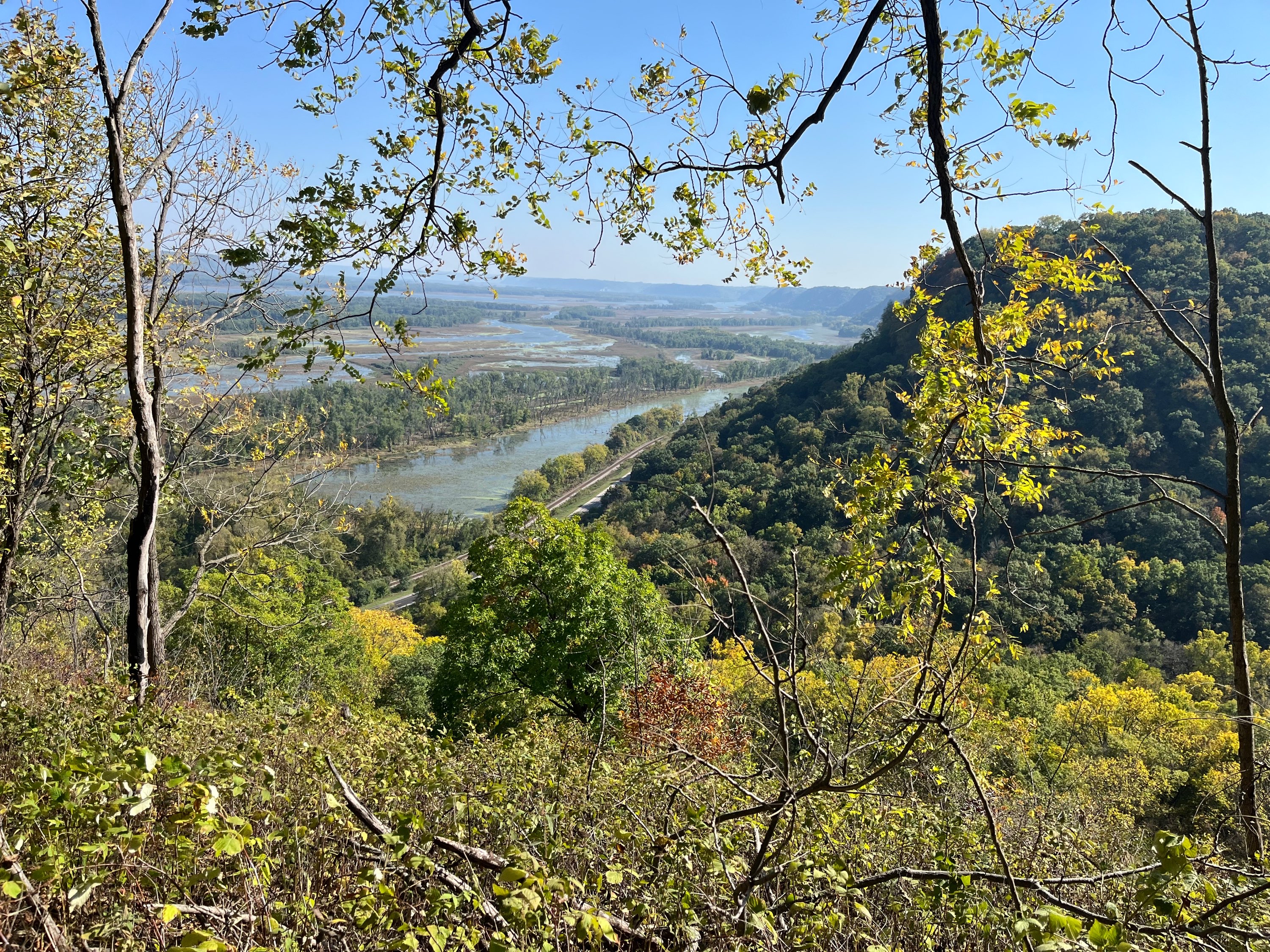
At Iowisota, we live between two faces. We call the steep, bold face on the front of the “South Bluff” Cedar Point, because of the ancient, gnarly red cedars (junipers) that have grown protected on the rock cliff for hundreds of years. I’ve never measured the height of the drop from the top of Cedar Point, but my guess is perhaps 75’. The face on the “North Bluff” is less abrupt; this bluff has a east-west oriented ridge above a south-facing hillside “goat” prairie that feathers into a series of short rocky ledges (with snake-harboring crevices) along the southeast face. The ridge above the goat prairie provides amazing unobstructed views over the Mississippi River valley to the south. The east-facing front face is mostly hidden by the trees below but is still a long enough drop that I wouldn’t care to go down that way.
I’m rather fond of our faces, even with all their dangers, and sometimes because of their dangers. Sometimes I look out over the view that they have watched for so long and reflect on the changes to the River and landscape. The Mississippi River was once uncontrolled and wild, the Upper Iowa River meandered alongside the Mississippi for several miles and joined in within view of the faces. Influencers of the landscape included fire, floods and beavers. The past 250 years have brought new influencers, including intense agriculture, logging, fire suppression, channelization, fertilizer and chemical pollution, introduction of invasive species, etc. It is sobering to contemplate what we have done, and perplexing to contemplate what we should do now. Ancient rocks, towering trees, and singing birds remind me that nature endures, even though it changes.
Meanwhile, we have been working to add opportunities for people to come share in experiencing nature and learning at Iowisota. On February 15th, we will have a wildcrafted soapmaking workshop. In March, I expect we will be boiling sap into maple syrup and will have several informal demonstrations. On April 11th, we will have a Shiitake mushroom inoculation workshop. We haven’t yet scheduled anything in May, but I’m contemplating foraging and bird topics. In June, we have tentatively scheduled archaeologist/historian Chris Hall to share a talk about the human history of the Mississippi River valley. I will continue to put events on the calendar and will consider requests for private retreats and stays. To keep up on what’s happening, check back on the website frequently, follow Iowisota on Facebook and/or subscribe to the newsletter/blog updates!


Comments