Suddenly Salad


I wouldn’t put it pasta me to do a cormy play on words… but every time I step out my back door, it seems that the landscape has suddenly erupted into a green carpet of salad! All the pictures here were taken this week at Iowisota. So many of our early Spring plants double as salad greens, so let me introduce you to a few of my favorites!
The young tender leaves of cutleaf coneflower/sochan (Rudbeckia laciniata) serve as a mild salad green. This plant from the sunflower or aster family is commonly found near woodland edges; later in the summer it will grow tall, the leaves will

become tough, and it will have a bright yellow flower. In Spring, dry stalks with old seedheads can sometimes be found towering over the tufts of young foliage, confirming their identity. Clusters of small leaves are tender and abundant right now, ripe for the harvest.
If you want to add a bit of tang to your salad, you might consider some cutleaf toothwort (Cardamine concatenate) or honewort (Cryptotaenia canadensis). Toothwort is in the mustard family, and all parts of the plant are edible. Their leaves have a moderately sharp flavor that adds a nice zip to a salad, but you only get to enjoy it for a few short weeks in the Spring before the plants die back and disappear.
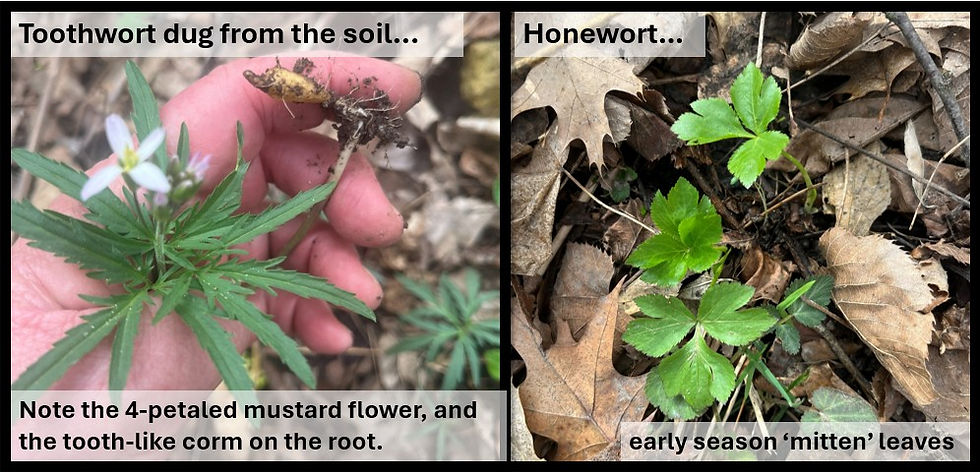
Honewort, also sometimes called Mitsuba, is a versatile plant in the carrot family. The carrot family includes lots of plants that have secondary compounds that can make them tasty or make them poisonous. For instance, poison hemlock is not a plant that you or Socrates want to mess with, so you want to make sure you recognize your plants from the carrot family! Fortunately, honewort is quite distinctive and the whole plant is edible. I use the young basal leaves in salads in Spring and Fall, and tender shoots and stalks in soups when my pantry runs out of celery in the summer.
For a splash of color, you can always throw a few violet (Viola sororia) flowers onto your salad.

The leaves of violet are mild and tasty. Other mild greens you might not realize are edible include chickweed (Stellaria media), bedstraw/cleavers (Galium aparine), and waterleaf (Hydrophyllum virginianum and H. appendiculatum). The leaves of both virginia waterleaf and great/appendaged waterleaf are often variegated when they emerge in the Spring, so they add an interesting texture and color to a salad. They are mild, but the leaves

are a bit fuzzy, so I don’t use a lot. There are a couple of species of cleavers around. They come up as cute, dainty little plants in the Spring, and in that form they too can be quite nice on a salad. As summer progresses, they will get big and tough. Chickweed does a bit better at staying mild and tender throughout the growing season.

About the cormy part… sometimes an edible part of the plant is a corm: a specialized underground structure that stores food energy for the plant to regenerate from. That tasty mustard toothwort? It is called toothwort because it has a tooth-shaped corm with a spicy horseradish flavor. Spring beauty (Claytonia virginica) is another plant with an edible corm. It is a delicate little plant in the purslane family that uses the energy in the corm to come up early each Spring. Older plants have larger corms. Like toothwort, you have to dig up the plant (which kills it) to harvest the corm. I have an abundance of spring beauty, so one year I decided I would harvest enough corms to see if they really make a viable vegetable. After digging, cleaning, and cooking my little clutch of corms, I found they tasted like beets without the color. It was a lot of work for little return, so I don’t need to do that again. The little plant with dappled leaves in the photo, white trout lily (Erythronium albidum), also has edible corms and leaves, but I haven’t ever tried them. The white trout lily has a reputation for causing vomiting if a person is sensitive or eats too much. Perhaps there is a reason I haven’t tried them yet. Seriously, when you add a new food to your diet, it is good to start with a small amount and to not try too many new things at once, so that you find out how your body reacts to that food.
Some plants are food, some are medicine, some are poison. And some are just pretty. Before you eat something, you need to be sure you know what it is! Artificial intelligence doesn’t always get it right, so I don’t trust it with my food choices. It is better to thoroughly do your homework and learn from trusted teachers and guides (books, people, and verified online sources). Learning what plants you can eat can be overwhelming, because there are so many and some look similar. I suggest you choose a few to start with and really get to know those plants. Choose a type of plant and watch how it changes throughout the growing season, so that you will recognize that plant at all growth stages. Add a few new plants each year, and before long you will have a huge catalogue in your head, and a tasty free salad every Spring.
If you come take a walk with me at Iowisota, I’m likely to point out my favorite edible plants along the trail. I’m going to try to do several informal “Women’s walk in the woods” this summer; my first one is scheduled for the afternoon of Sunday April 18th. With the woodland path so green and lush right now, I’ve also added a wildflower walk (not just for women!) on Saturday April 25th. On the weekend of July 18-19, we will have author and foraging guru Samuel Thayer here for a workshop; I’ll get the details and sign-up for that posted soon.


Comments